The Empress Mosaic Project
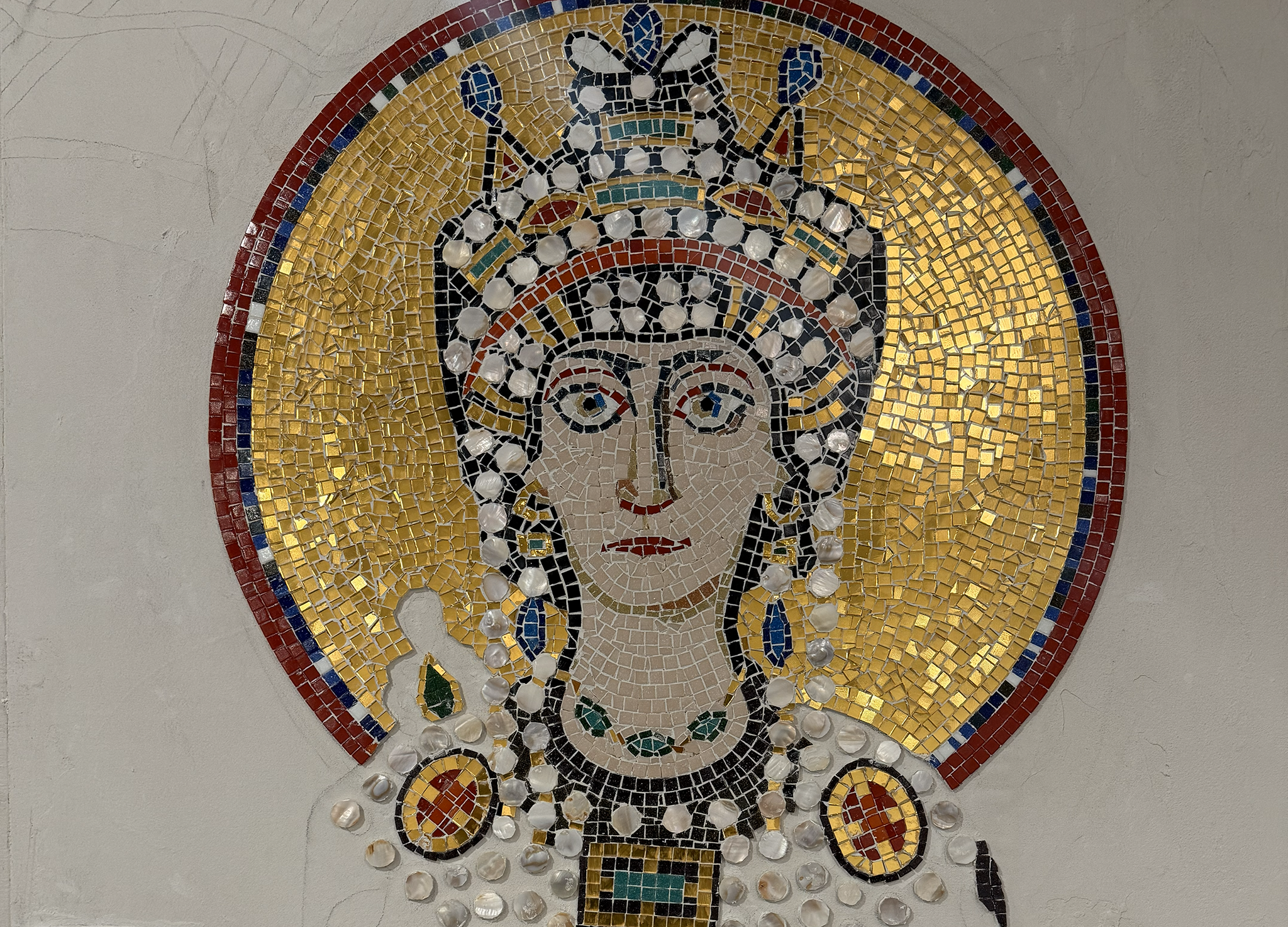
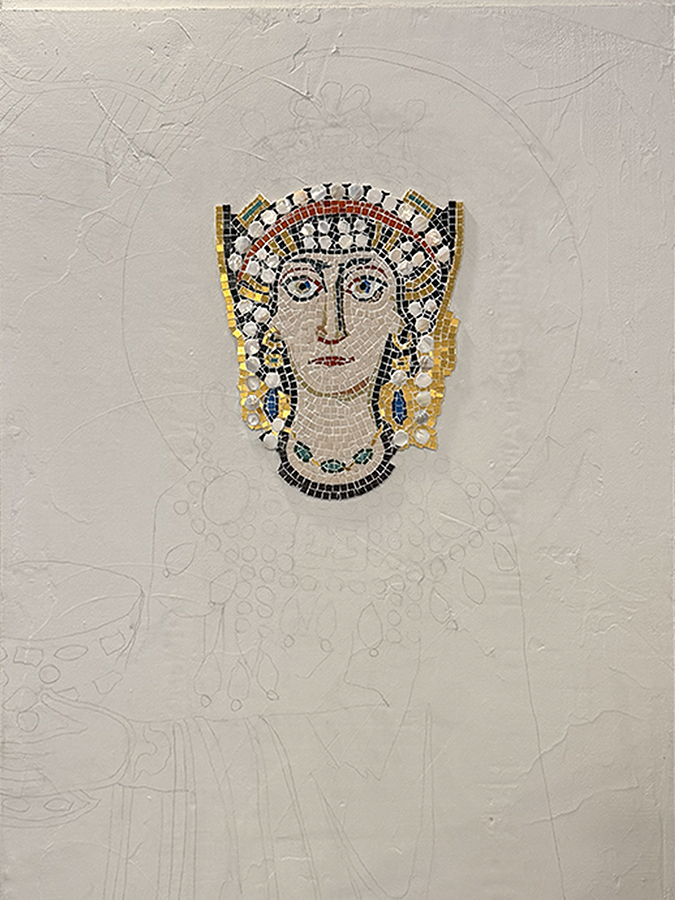
The Empress Mosaic is a living homage to Empress Theodora of Byzantium — power, faith, and an early advocate for women’s dignity — translated into a research-informed stained glass mosaic at The Collector’s Room.
Inspired directly by the 6th-century mosaic in the Basilica of San Vitale, this contemporary replica brings together Byzantine visual language, careful study, and slow, old-world craft. Each tessera is placed by hand, building an image that is both faithful and distinctly of our time.
Medieval Mosaicists & Changing Practices
This contemporary mosaic study of Empress Theodora is also part of a Art History research project, which asks: What has changed in materiality since late antiquity, and what was life like for the medieval mosaicists who created works such as those in San Vitale?
In the 6th century, mosaic-making was a collaborative workshop practice. Teams of artisans worked under imperial and ecclesiastical patronage, with apprentices preparing mortar and sorting tesserae while senior craftsmen executed garments, ornament, and backgrounds. Only the most skilled masters were trusted to render faces and hands—the areas believed to carry spiritual presence. Their names were rarely recorded; mosaicists were part of a collective craft rather than individual authorship.
Materially, their world differed greatly from ours. Tesserae were cast in specialized glass workshops using natron-based soda-lime glass, mineral pigments, and gold-leaf sandwiches. Medieval mosaicists did not cut every piece by hand; most tesserae arrived pre-shaped, and artisans selectively chipped them for fit, similar to my contemporary method. Installation required long hours on scaffolds, working quickly before the lime plaster set—precision demanded both skill and endurance.
Today, artists work with stable adhesives, modern backers, and uniformly manufactured glass. What has changed most is not the core technique, but the entire support system of materials, workshops, and apprenticeship. Medieval mosaicists trained for years within structured workshops; contemporary artists often reconstruct these methods through study rather than communal tradition.
This project engages directly with those historical processes—tessera by tessera—honoring both medieval craftsmanship and modern inquiry while exploring how light, color, and devotion to technique continue to transmit meaning across fifteen centuries.
In the Mosaic Studio
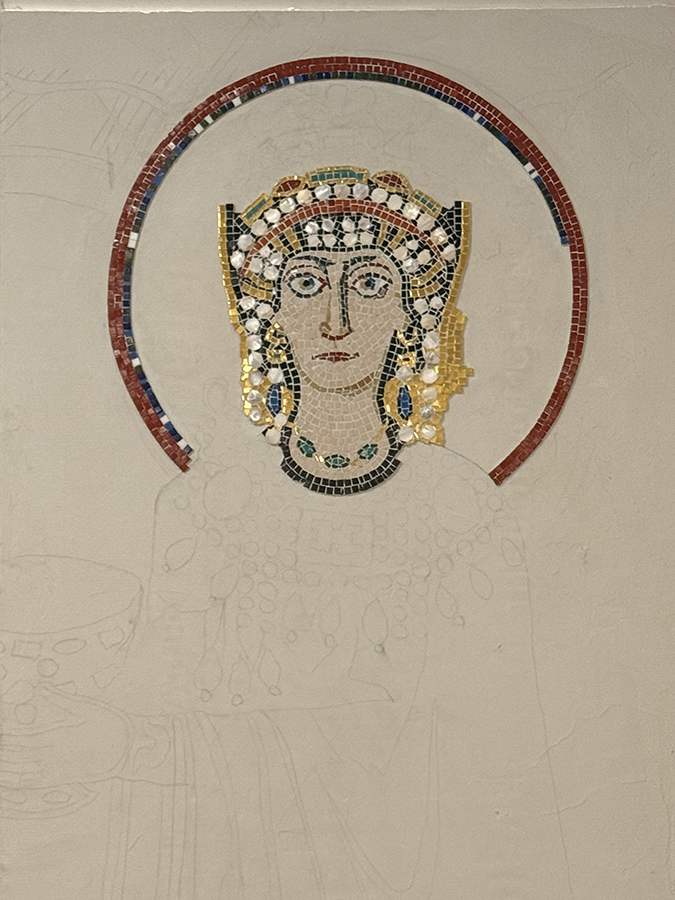
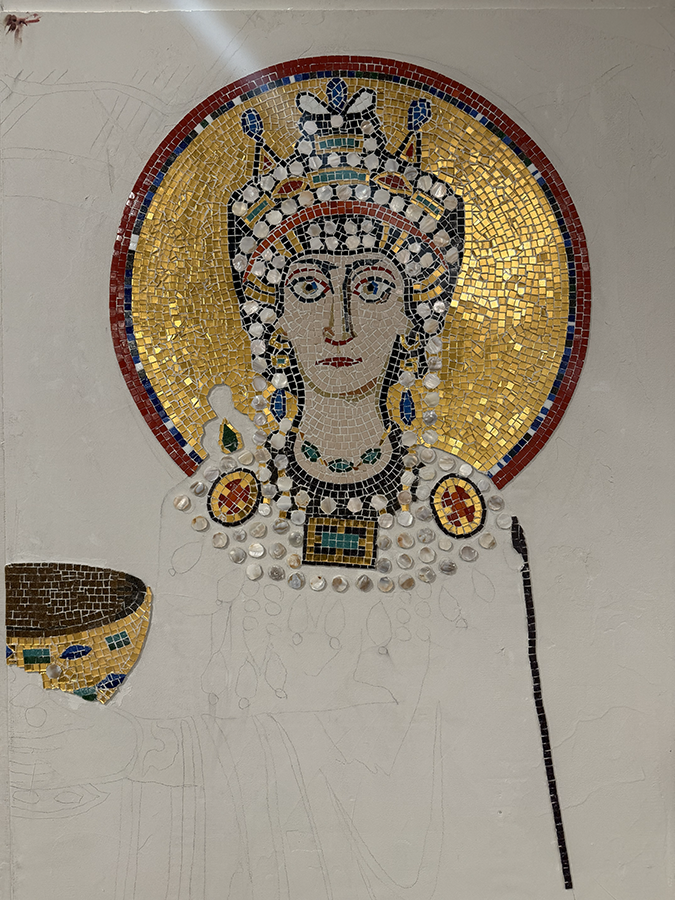
Short preview of the mosaic’s current state: face, crown, and the colored halo ring taking shape in glass and gold.
A Contemporary Replica with Deep Roots
This mosaic is a contemporary replica of the famous portrait of Empress Theodora in San Vitale, Ravenna. The goal is not to copy mechanically, but to re-enter the visual world of the 6th century through careful looking, drawing, and material study.
Theodora stands as an emblem of courage, intellect, and concrete action toward the dignity of women in a world that rarely granted it. In this replica, her poise, gaze, and courtly surroundings are rebuilt tessera by tessera, so that her presence remains luminous and commanding — even for a contemporary viewer.
This work is part devotional study, part art-historical research, and part experiment in bringing Byzantine light and color into a modern gallery context.
Process & Materials
- Glass: Mixed stained glass selected for color, translucency, and light play.
- Method: Pre-sized tesserae, selectively snipped for organic irregularity and flow.
- Setting: Each piece placed by hand to echo the rhythm of Byzantine mosaics.
- Adhesion & grout: Archival mosaic adhesives and grout tuned for contrast and iconography.
- Substrate: Rigid, mosaic-suitable backer panel for long-term display.
- Scale: Approximately 3 ft × 5 ft finished dimensions.
Materials may be refined during construction for longevity and aesthetic harmony.
How the Project Unfolds
- Early Oct 2025: Project start, drawing studies, and initial layout.
- Oct–Nov 2025: Face, crown, and halo developed in carefully chosen glass.
- Dec 18, 2025: Creation period concludes; final tesserae set.
- Through Jan 31, 2026: Public display in the gallery.
- Jan 27, 2026: Work becomes available for acquisition.
Visitors are welcome to follow the project across this timeline — seeing the shift from early blocking-in to refined details, from raw panel to finished contemporary replica. The process itself becomes part of the experience of the artwork.
See the Mosaic in Progress
The Empress Mosaic is being built on-site at The Collector’s Room. During open hours, visitors can see the work on the studio bench and, when the artist is active, watch live placement sessions.
Questions about technique, history, tessera size, or color choices are welcome. This is a space where study, making, and conversation overlap.
Location:
76 W Tabernacle · Green Gate Village
St. George, Utah
Contact:
Email: info@crgallery.com
Phone: (435) 313-4532
Frequently Asked
Is this a replica or an original work?
Is the glass fully hand-cut?
Can I see it while it’s being made?
Will there be prints or reproductions?
Snapshots from the Bench
A few frames from different stages of the Empress Mosaic. Use the arrows below to move through the slideshow. New images can be added at any time.
Research & Further Reading
- Neri, E.; Jackson, M.; O’Hea, M.; Gregory, T.; Blet-Lemarquand, M.; Schibille, N. (2017). Analyses of glass tesserae from Kilise Tepe: New insights into an early Byzantine production technology. Journal of Archaeological Science: Reports 11, 600–612.
- Dal Bianco, B.; Russo, U. (2012). Basilica of San Marco (Venice, Italy/Byzantine period): Nondestructive investigation on the glass mosaic tesserae. Journal of Non-Crystalline Solids 358(2), 368–378.
- Bonnerot, O.; Ceglia, A.; Michaelides, D. (2016). Technology and materials of Early Christian Cypriot wall mosaics. Journal of Archaeological Science: Reports 7, 649–661.